Build backward from a clear board
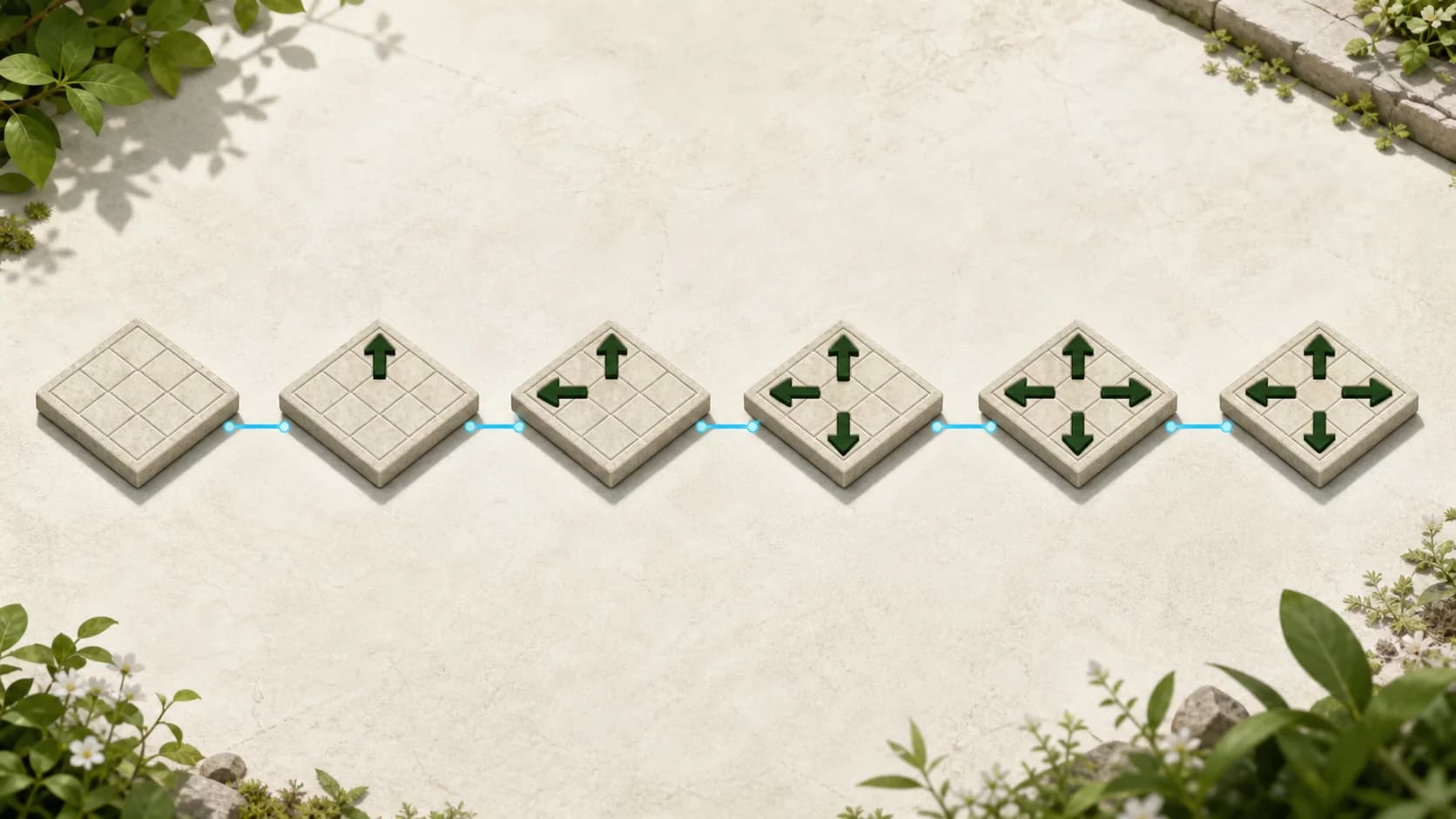
Arrow Puzzle uses reverse generation. Instead of placing random arrows and hoping a solution exists, the generator starts from a state it understands and adds pieces in an order that can later be undone.
That recorded reverse order becomes proof that at least one valid solution exists.
Each new piece keeps an exit story
When a piece is added, the generator knows which later removals will open its route. Special pieces and walls are placed within the same dependency structure.
The finished board may look tangled, but its relationships were created from a sequence that can be reversed.
Difficulty comes from hiding the chain
An easy level exposes several clear routes. A harder level uses longer dependency chains, tighter wall placement, and special pieces that affect several lines.
Difficulty is not the same as randomness. The board can be hard to read while still having a known path to completion.
What solvable does not mean
Solvable does not mean every arrow is immediately playable or that every move is equally useful to a person. It means the starting board has a valid sequence that clears it under the game rules.
Hints use the current board state to guide you toward a valid next move when the dependency chain is difficult to see.
Why this matters for players
You can approach a difficult position as a logic problem, not a guessing test. If nothing looks open, one of your assumptions about a route, wall, or special arrow needs another check.
That trust is the heart of the game: the board is asking you to discover its order.