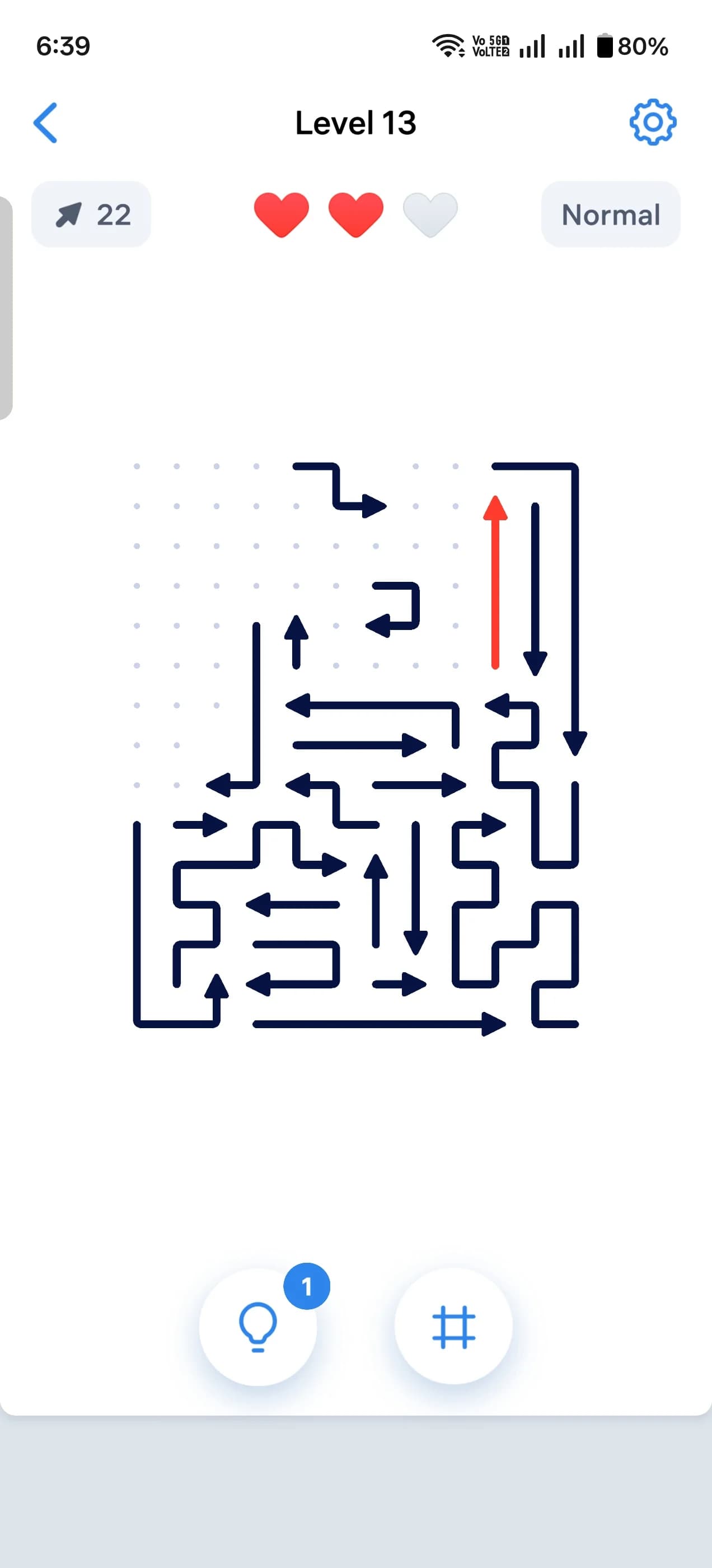
The goal
Clear every arrow from the board. Each arrow can leave only in the direction it points, so the order of your moves matters more than speed.
A level ends when the board is empty. If an arrow has another piece or a wall in its route, it cannot leave yet. Clear the piece causing the block and check the route again.
Read the route before you tap
Start at the arrowhead and trace a straight line toward the edge. A clear line means the move is safe. A line that meets another arrow, a wall, or part of a long snake arrow is blocked.
The first useful scan is around the outside of the board. Edge arrows often have short exit routes, which makes them easier to verify.
- Follow the arrowhead, not the shape behind it.
- Check every occupied square along the route.
- After a move, scan the opened row and column again.
What a wrong move costs
A blocked tap costs a life in modes where lives are active. The board does not need fast guesses, so pause and trace the full path first.
Hints are best used when several arrows look possible but you cannot see which move unlocks the next part of the board. A hint identifies a safe move without playing the whole level for you.
A simple opening routine
First, scan all four edges. Second, find arrows that point directly out with nothing in front of them. Third, make one safe move and scan the changed lines. This small loop is more reliable than trying to plan the entire board at once.
Complex boards become manageable when you treat each safe exit as new information.